Ostranauts 1.0 Launch
August 3, 2026 — full Steam release built on Fire in the Hold
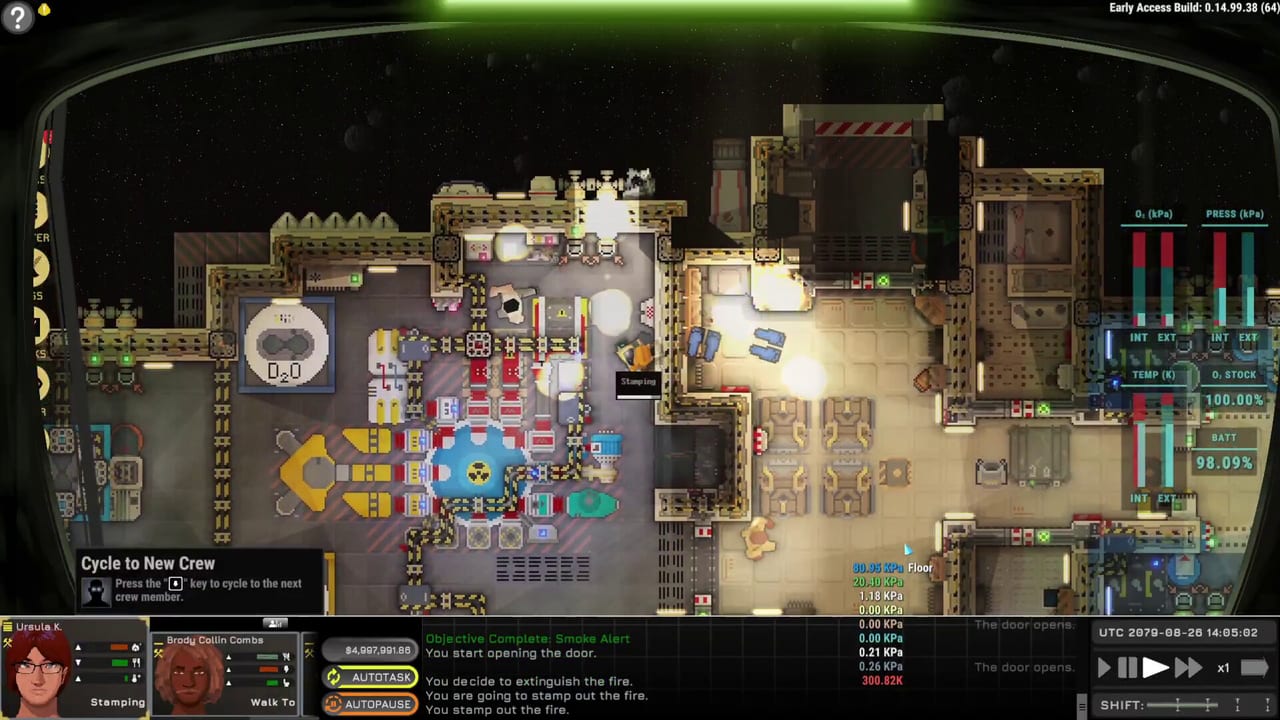
Blue Bottle Games released Ostranauts 1.0 on Steam on 2026-08-03, closing a long Early Access arc that began in September 2020. The launch is not a separate game from the Fire in the Hold era — it is the polished, story-complete, stability-focused capstone on top of combat, Ceres, and asteroid mining systems that landed earlier in 2026. Whether you are brand new or returning from a 2023 save, treat 1.0 as a reason to relearn how your ship pays the bills and survives the outer lanes.
What 1.0 actually shipped
Dan Fedor’s launch messaging emphasized bug fixes, performance, quality of life, and narrative closure rather than another massive mechanics drop on release day. That framing matters for captains: you should not expect an entirely new tutorial on August 4, but you should expect fewer exploding reactors, more reliable weapons tracking, and station maps that finally match the promise of the solar system.
Headline deliverables for 1.0 include:
- Full Steam 1.0 status — no longer Early Access; AppID 1022980 is the release SKU
- Ceres Affair conclusion — story threads around Ceres, the VHS, Ben Choong, and faction motives receive answers and branching ripple effects
- Bounty hunting system — dead-or-alive warrants on corporate security boards; mid-game income layered on Ship Combat — see Bounty Hunting
- Steam Workshop — in-game MODS menu, 40+ community mods at launch announce; legitimate modding via Steam Workshop page
- Improved tutorial flow — onboarding polish for new captains; still pair with Getting Started for shift and mortgage rhythm
- Filled station maps — placeholder layouts replaced or expanded at Tharsis Landing (Mars), Labyrinth, Voltaire on Deimos, Jade Rabbit on Luna, Atlantis hubs, and other stations named in launch notes
- Stability pass — hotfixes on top of Fire in the Hold for reactor temperature, weapon arcs versus crossing targets, sudden hull detonation edge cases, and dock clipping
Single-player remains the only campaign mode. There is still no multiplayer mode — your crew are AI actors, not friends on Discord.
Fire in the Hold context (combat, Ceres, mining)
You cannot read 1.0 without understanding Fire in the Hold, the milestone that arrived before launch and rewrote mid-game risk.
That update introduced ship-to-ship combat as a systemic layer, not a scripted set piece. Point defense cannons, mass throwers, missile launchers, decoy systems, and armor cladding joined the parts catalog — full guide at Ship Combat. Mining-industrial gear from factions like Soyuzneft doubled as improvised weaponry — belter economics and belter warfare share the same hardware; read Asteroid Mining.
Ceres became the gravitational center for armed traffic — map at Ceres Conflict Zone. Proxy wars between corporate alliances, pirate opportunists, and bounty hunters overlap salvage lanes. Hull fire and smoke spreads through damaged compartments — Fire and Smoke explains extinguish workflows and faction standing recovery.
If your last play session predates Ceres combat:
- Your old “safe” routes may now intersect armed patrols
- Fitting only cargo grabbers without power budget for defenses is a choice, not an accident
- Docking at new Ceres-adjacent stations assumes you read COMMS and clearance rules under fire stress
The Guides hub walks flight, salvage, and atmosphere first; combat guides assume you can already undock without venting the bridge.
What new captains should learn first
Never played before? Start here in order:
- Character Creation — careers, traits, mortgage vs debt-free starts
- Getting Started — OKLG, PDA objectives, six-hour shift mortgage clock
- How to Fly and Dock — Newtonian flight, COMMS, clamps
- How to Salvage — permits, uninstall, haul, sell
- Manage Atmosphere — O2 near 20 kPa, scrubbers, suits
Mid-game after solvency:
- Ship Combat — PDCs, railguns, Ceres loadouts
- Asteroid Mining — tether clusters and ore sales
- Bounty Hunting — 1.0 warrants (not day one)
Use Tools checklists when repetition sets in — atmosphere checklist, salvage run checklist, mortgage shift planner.
Do not rush Ceres combat on day one. Learn peaceful boneyard economics until shift planning and life support are boring.
What returning captains should relearn
Veterans skip tutorials at their wallet’s peril. Revisit these habits even if you “already know Ostranauts”:
Shift and mortgage rhythm. Payments still tick on six-hour shifts for financed hulls. Idle station role-play does not pause debt. Re-read Getting Started finance notes and run one blank mortgage shift planner table.
Station geography. Maps you memorized in Early Access may have new rooms, vendors, or dock geometry. Walk Tharsis Landing, Labyrinth, Voltaire, Jade Rabbit, and Atlantis hubs on foot once before treating them as old hat — see the Map hub and Ceres Conflict Zone.
Salvage economy. Permit costs, vendor moods, and repair-before-sell math still gate income. Patch hotfixes occasionally nudge prices — confirm against salvage economy before you plan a retirement haul.
Combat loadouts. Weapons expect supporting modules, power, and ammo chains. A missile launcher without tracking fixes from post–Fire in the Hold patches wastes credits. Test on drones or quiet targets before betting the hull on a Ceres intercept — Ship Combat guide.
Bounty and Workshop layers. 1.0 added warrant boards and Steam Workshop mods on top of Fire in the Hold combat — read Bounty Hunting and Steam Workshop before modding a main save.
Story flags. The Ceres Affair conclusion respects prior choices. Long-return saves may trigger dialogue or faction reactions you do not remember earning — read PDA notes before you pick fights.
Launch week hotfix pattern
Blue Bottle shipped rapid hotfixes after Fire in the Hold and continued that cadence into 1.0 week — reactor stability, weapon hit detection against high crossing velocity targets, and sudden ship destruction edge cases appeared in public notes. Treat launch month as live software: save before experimental refits, and read Steam news before you blame your piloting.
How 1.0 fits the wider wiki
- Review — subjective take on whether 1.0 delivers on years of promise
- Guides hub — mechanics-first walkthroughs updated for release assumptions
- Updates hub — future patch summaries when economy or combat shifts again
- Fire in the Hold — April 2026 milestone detail
- Gamepad and Steam Deck — controller support since Fire in the Hold
- Map hub — OKLG, Ceres, and outbound routes as station maps fill in
Official channels remain Steam news, Blue Bottle Discord, and community wiki.gg articles for raw patch text. This page translates launch facts into captain priorities: relearn life support and debt timing, respect Ceres combat as optional mid-game spice, and walk new station maps before you trust muscle memory.
Welcome to 1.0 — the solar system is still trying to bankrupt you, but now it has a ending worth flying toward.
Frequently Asked Questions
Quick answers for spacers who want to stay alive.
When exactly did Ostranauts 1.0 release?
Version 1.0 launched on Steam on 2026-08-03, ending Early Access for AppID 1022980. Fire in the Hold combat and Ceres content shipped earlier in 2026 as the foundation for launch polish.
Is Fire in the Hold included in 1.0?
Yes. Ship combat, Ceres faction conflict, mining gear, and related systems are part of the release build. 1.0 focused on stability, story closure, and completed station maps rather than replacing combat outright.
Should returning players start a new save?
Not required, but walk new station maps and reread Getting Started plus combat sections before Ceres runs. Old saves may have story flags and hull layouts that behave differently under 1.0 fixes.